

Each week many sector actors such as umbrella organizations, LIPs, advocacy organizations, and researchers share news, reports, insights/opinions, events, and more. We'll curate and summarize the latest content of interest. Much of this information is shared via email newsletters and on LinkedIn. We encourage you to subscribe to the newsletters and organizations of interest to you to stay updated on what matters most in your work.
News from the sector
New Funding Opportunities - July Monthly Update
Looking for new funding opportunities? We've recently added a range of new funding calls to SettleNet.org. Whether you're seeking support for innovative projects, capacity building, research, or community initiatives, SettleNet.org is regularly updated with opportunities relevant to the immigrant and refugee-serving sector. Join and browse through the Grant and Funding Opportunities group to explore the latest postings, review eligibility requirements, and keep an eye on new opportunities as they're added. Staying connected on SettleNet.org is one of the easiest ways to stay informed and ensure you don't miss potential funding for your organization.
Black-Mandated Funding Framework
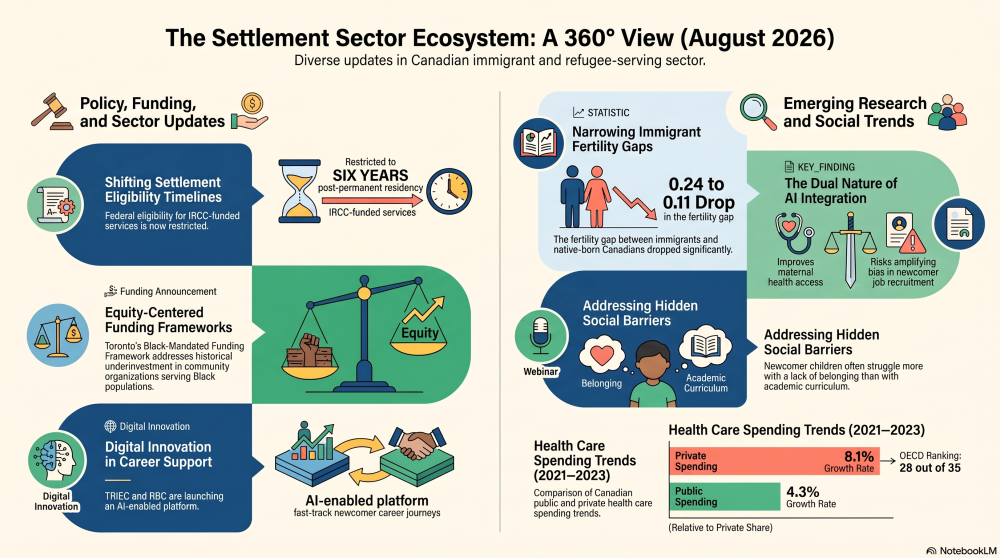
The Black-Mandated Funding Framework aims to address funding gaps and historical underinvestment in community organizations and groups that serve Toronto’s Black communities. The model provides an equity-centered approach to addressing anti-Black racism in the City’s community funding processes.
Professionals who work with immigrants wanted as research participants
Wellesley Institute is conducting research building on our Thriving in the City framework to better reflect the additional resources and services that new immigrants require to live a healthy life in the GTA. For the purposes of this study, new immigrants are immigrants who obtained permanent residency through an economic immigration pathway within the past five years. We are holding consultations with professionals with relevant experience to provide feedback on the existing Thriving in the City framework to understand if the listed items address the needs of new immigrants in the GTA and would help them thrive.
AccessTO Community Agency Staff Engagement survey
The City of Toronto wants service provider input to help make city services more responsive and accessible for undocumented Torontonians. Many City of Toronto services are available to all residents of Toronto, regardless of immigration status. The City is interested in learning about the experiences of Undocumented Torontonians in accessing City services. Undocumented Torontonian is the term used by the City of Toronto to describe residents who do not have any valid immigration status. Additional terms used in the sector include person without status, precarious migrant, and/or non-status person. The city is surveying undocumented Torontonians as well as staff who serve them.
Accessible Employment: Insights for Settlement Professionals ❘ L'emploi accessible : perspectives pour les professionnels d'établissement
OCASI, in collaboration with SMILE Canada Support Services, invites you to a Hybrid Forum: Accessible Employment Pathways for Newcomers: Insights for Settlement and Employment Professionals. This full-day hybrid forum is designed to enhance settlement workers’ capacity to support immigrants and refugees with disabilities, chronic illness, trauma-related experiences, mental-health conditions, or other accessibility-related barriers in accessing equitable employment. The sessions will focus on the practical application of knowledge related to employment barriers, human rights obligations, accessible hiring practices, and referral pathways, aligning with priorities in workforce integration, rights and safety, and career development. Date: October 8, 2026 Time: 8:30 am - 5:00 pm.
Minority vs Minority Racism is Exploding (podcast episode)
San Grewal and Rahim Mohamed discuss Robyn Urback's opinion piece in the Globe and Mail, titled, “Like a bad ex, Donald Trump is accidentally making Canada become its best self”. Indeed, national pride seems to be at an all-time high, but is it warranted? After all, hate crimes are on the rise, two Jewish bakeries were vandalized last weekend, and a group of white supremacists just threw a "family-friendly festival” called Bigotfest in North Bay.
The Impact of Changes to Settlement Service Eligibility on Newcomers in Small, Medium and Remote Communities (webinar recording)
Starting April 1, 2026, the federal government restricted eligibility for IRCC-funded settlement services for economic immigrants and their dependents to six years after obtaining permanent residence. This restriction will be tightened further to five years as of April 1, 2027, aimed at encouraging earlier service use, particularly for language training and employment. Reductions in the budget of the Settlement Program will also affect the availability of services, with IRCC needing to identify approximately $100M in savings for 2026-27 and further savings in the following two years. These changes are expected to present unique challenges for newcomers to small, medium, and remote communities, particularly secondary migrants. The workshop speakers discussed the impact of these changes in the context of broader shifts across the sector, as well as the strategies that service providers in small, medium, and remote communities are using to adapt and respond.
The Toronto South West LIP Weekly Update 349
Contents: Essential Information; You Wouldn't Want to Miss, Professional Development Sessions & Webinars for Service Providers, Indigenous History Month Events and Programs, Research and Resources for Service Providers, Resources and Programs for Newcomers, Funding Opportunities, News Headlines, Job Postings.
S5-Episode 4: AI, rights, and equality: Who gets to benefit and who gets left behind?
AI is changing nearly every sector today, from healthcare to employment to housing and beyond. In this episode, Commissioner Kosseim speaks with Professor Jake Okechukwu Effoduh, assistant professor at the Lincoln Alexander School of Law of Toronto Metropolitan University. They discuss the broader social impacts of AI systems on marginalized communities and why strong legal frameworks are essential for protecting fundamental rights and ensuring yesterday’s discrimination does not become tomorrow’s prediction.
The Hidden Pain of Not Having Friends - Many newcomer children suffer quietly because they cannot find belonging in a new school (podcast episode)
When a child moves to a new country and seem to struggle to settle into school, adults often focus first on school performance. They ask if they are reading at a grade level. Or are they writing properly? Are their marks okay? Do they understand the teacher? Are they completing their homework? All these questions matter. But there’s another question we don’t ask enough, which is does this child have even one friend at school? Not five friends or a big group, but one child they seat with and talk to. For many newcomer children, the hardest part of moving to Canada isn’t the new curriculum, the accent, weather, or the classroom rules. It’s walking into school every day and feeling like no one knows or understands them. It’s hearing classmates talk about birthday parties, sports teams, jokes, games, and weekend plans and feeling like they are watching life happen from outside the window.
How the Global South finances the educated workforce in Canada and other wealthy countries
Skilled immigrants help rich countries thrive, but the countries that trained them often absorb the cost. Canada should help rebalance the bargain. Canada’s debate about immigration usually revolves around borders, population growth and labour shortages. Far less attention is paid to another critical question: Who is paying the price for the highly educated immigrants on whom wealthy countries increasingly depend? In many cases, the answer is the Global South.
Welcome to CanadaLogin
Accessing Government of Canada programs and services will be easier than ever. Use a single, secure sign-in to access all participating federal programs and services.
Women RISE Toronto Campaign
We are the Women RISE Leaders at Bangladeshi Canadian Community Services (BCS)—a youth led group of racialized and immigrant women building leadership, advocacy skills, and economic participation across Toronto. Through workshops, mentoring, and community mobilization, we represent a growing network of young women taking action on the issues that directly shape our lives. The Women RISE project is supported by Women and Gender Equality Canada. In 2025, we partnered with BCS to design and conduct a Community-Based Research (CBR) to understand the economic realities of racialized and immigrant women. A total of 255 racialized women and girls participated in surveys, 20 participated in focus groups, and others took part in art-based activities across the Greater Toronto Area. These findings reflect lived knowledge— not only statistics—and point to an urgent need for policy and practice interventions.
Webinar: Nine Revenue Diversification Strategies for the Settlement Sector (webinar recording)
With the Canadian non-profit sector facing recent pressures such as rising costs, increased community needs, and funding reductions, exploring diverse revenue methods is more important than ever. This is especially the case for the organizations in the settlement and integration sector who often rely on only a few funding sources. Because exploring new funding options can feel difficult and overwhelming, especially considering the existing amount of work that settlement organizations are facing these days, having a clear idea of what strategies exist and how to approach them can help. This webinar introduces participants to the nine revenue diversification strategies within the Thriving Non-Profits framework and provides practical guidance on how organizations can begin building greater financial resilience over time.
CLEO July 2026 newsletter - Legal information and news from across Ontario
Each month, we share useful legal information, tools, and learning opportunities from CLEO and organizations across Ontario. Here are a few resources that caught our attention this month.
BC Migrant Worker Service Map Update 2026/7
AMSSA created the BC Migrant Worker Supports Service Map to support organizations and individuals with easier navigation of supports and resources available to migrant workers across BC. The map can be used to find organizations that support migrant workers based on region and service type and provides information about the organization’s website, contact information, languages offered, and after-hours support. We encourage you to proceed to the next page if your organization is already listed on the BC Migrant Worker Supports Service Map in order to confirm we have the most up-to-date information.
Service Scan 2026: Organizations Supporting Temporary Foreign Workers and Vulnerable Workers in BC
In April of 2020, AMSSA launched the project "Increasing Capacity to Support Temporary Foreign Workers in BC," funded by WorkSafeBC. Now in the program's seventh year, the current survey is intended to assess the ongoing challenges, best practices and training needs of individuals and organizations who provide support to TFWs in BC. The results of this survey will be used to develop resources to support service providers, as well as provide an insightful snapshot of the TFW support sector in BC.
Recognize and Respond: Addressing Human Trafficking in the Hospitality Industry
Building on the foundation of “Your Role in Preventing Human Trafficking: Recognize the Signs”, “Recognize and Respond: Addressing Human Trafficking in the Hospitality Industry” incorporates hotel-level feedback and features interactive scenarios, separate learning paths for associates and managers, a mobile-friendly design, and increased guidance on responding to potential trafficking situations. Currently available in Arabic, Chinese (Simplified), English, French, and Spanish, the training is approximately 60 minutes for associates and approximately 85 minutes for managers.
DWatch wins unanimous Supreme Court ruling removing statutory barriers to challenging decisions of the federal Ethics Commissioner and similar tribunals across Canada
Democracy Watch’s legal arguments (and reply arguments) at the SCC contended that the Parliament of Canada Act states clearly that the Ethics Commissioner does not operate under Parliament when enforcing the Conflict of Interest Act (COIA), and that Parliament has no legal role in reviewing the Commissioner’s rulings. As the FCA acknowledged in its ruling, the Commissioner was established in 2004 to take decision-making power on alleged violations away from partisan politicians. In addition, DWatch (and the eight citizen organizations that intervened in the SCC appeal – click here and see list under “Parties” tab) argued that it is essential under the Constitution and the rule of law principle that the courts can review decisions of tribunals like the Ethics Commission.
What is the most important issue facing your country?
The top answer is hardly a surprise: by a wide margin, citizens across the OECD as a whole, and in most individual countries (including Canada), are most likely to be concerned about inflation. But the next two most often cited issues, OECD-wide, are perhaps less expected, at least to Canadian eyes: crime or violence, and poverty and social inequality. These are followed closely by immigration, health care and unemployment. In Canada, inflation is following by housing and health care, rather than crime and poverty.
Welcome to Bridge Together’s Connection & Resource Hub
Connecting sponsors, privately sponsored newcomers and settlement providers for stronger, seamless support. Private refugee sponsorship is a powerful pathway to welcome newcomers to Canada, but strong outcomes depend on strong coordination. Sponsoring groups and settlement service providers each play essential roles. When they are better connected, sponsored newcomers receive more seamless, responsive, and effective support as they settle. This platform exists to strengthen collaboration, knowledge-sharing, and coordination between these partners, helping build clearer pathways, stronger relationships, and better settlement experiences across Canada.
Canada by the Numbers: Canadian Unity - Where Do Things Stand? (webinar recording)
An examination of where Canadians stand on national unity, as debates around regionalism, national identity, and the future of the federation gain renewed prominence amid the prospect of referendums in both Quebec and Alberta. Jack Jedwab presents new Léger polling for the Association for Canadian Studies, followed by commentary from the Honourable Stéphane Dion and Professor Lisa Young.
Nervous System Care & Sustainable Frontline Practice
This webinar offered frontline workers practical strategies to recognize early signs of nervous system strain, strengthen boundaries, and apply somatic micro-skills before stress, burnout, or moral injury accumulate. Grounded in a trauma-informed, culturally responsive, and non-pathologizing approach, the session reflected the realities of frontline work across Atlantic Canada.
ARAISA newsletter
In this week's newsletter: Strengthening youth engagement, Funding opportunities, Sector needs for the Federal budget 2026, Understanding Bill C-12, Barrier Breakers Youth Program, New data on immigration, We're hiring!, Modernizing nonprofit finance, More Events, Interesting Reads.
North East Toronto LIP newsflash July 29
Contents: Announcements, Events, Webinars, and Professional Development for Service Providers, Program Updates for Newcomers, Funding Opportunities, Sector News and Reports, Resources, Previously Listed Resources.
Daria Lysenko on what it's like to work in newcomer settlement (podcast episode)
In this episode, I'm speaking with Daria Lysenko, who's passionate about helping newcomers settle and find their footing in Canada. Daria spent most of our conversation taking apart a bias I had carried for a bit now. Which is that newcomers/immigrants should mostly be the individuals who work in the immigration sector.
From a Day to a Movement: The Evolution of Language Advocacy Day in Canada
In a country defined by diversity, language is more than a tool. It’s a gateway to safety, dignity, and belonging. The Language Access Coalition of Canada (LACC) was built on a simple but urgent idea: language access is a human right, and systems must be designed to reflect that reality. Today, LACC stands as a national coalition advocating for structural change across public services, from healthcare and justice to housing and emergency response. Our work is guided by a clear set of policy priorities: proclaiming February 22nd as Language Access Day in Canada, expanding active language offers beyond English and French, ensuring accessible emergency communication (including ASL and LSQ), supporting Indigenous language revitalization, strengthening French-language awareness, and establishing ethical guardrails for AI in language services.
Electronic Monitoring of Employees in Ontario: Transparency is Not a Choice
Technology has made it easier than ever to monitor how work gets done. With the rise of hybrid and remote work, digital productivity tools, and AI‑enabled systems, workplace monitoring has become a key compliance issue for Ontario employers. Ontario does not have a single, comprehensive statute governing employee privacy in the workplace. However, under the Employment Standards Act, 2000 (“ESA”), employers with 25 or more employees in Ontario must have a written policy on electronic monitoring in place. This requirement was introduced through Bill 88, Working for Workers Act, 2022 and continues to apply each year.
RBC Foundation supports TRIEC’s new digital platform to help skilled newcomers fast-track their Canadian careers
Toronto Region Immigrant Employment Council (TRIEC) announces a new digital innovation initiative powered by seed funding from RBC Foundation. The two-year seed funding will support the development of a technology-enabled platform designed to help skilled newcomers fast-track their Canadian careers. The platform is being designed to support every stage of a newcomer’s career journey. Through personalized technology-enabled solutions, the platform will help newcomers navigate career opportunities with confidence while helping employers expand access to highly skilled professionals. Using AI-enabled tools, it will help users identify opportunities aligned with their skills, experience, and career aspirations while providing tailored guidance to navigate the Canadian labour market and help accelerate their career success.
Canada expands online passport renewal to all eligible adults
The Government of Canada is committed to making life simpler and more convenient for Canadians. This includes a modern passport program that delivers secure, user‑friendly digital services that save time, reduce in‑person visits and make passport renewal easier.
Museum independence cannot be conditional in Canada
On June 27, the Canadian Museum for Human Rights (CMHR) opened Palestine Uprooted: Nakba Past and Present, an exhibition exploring Palestinian history and culture through photographs, video testimony, artifacts, art, and interactive displays. The museum describes the exhibition’s subject as the human rights violations associated with the “ongoing forced displacement and dispossession of Palestinians.” It is scheduled to be on display at the Winnipeg-based national museum until November 2028... The Canadian Museum for Human Rights, like all museums, should not be insulated from public debate. Indeed criticism from affected communities, scholars, visitors, and civil society organizations can help expose omissions, improve institutional practices, and contribute to the very reflection and dialogue that the CMHR was created to encourage. However, such concerted calls to pause or halt an exhibition before it has even opened are alarming. These calls cast a chill on both the free speech and creative independence of curators in future exhibitions at the Canadian Museum for Human Rights and other national institutions.
Interesting research
Enhancing Access for Immigrant and Refugee Families: A Conceptual Pathway Framework for the Integration of Social and Mental Health Services for Immigrant and Refugee Families
While Canada has established a robust settlement program, significant limitations remain in developing coordinated, integrated, responsive, and sustainable service pathway systems. Contributing challenges include limited awareness and underutilization of pre-arrival and settlement services, as well as a predominant focus on short-term “basic” resettlement needs rather than on long-term mental health and primary service supports. Using a community-based participatory research and mixed-methods research design, we co-designed a concept-to-practice Service Pathways Model comprising four core components: (1) a centralized referral database, (2) a systems navigator role, (3) mobilization of pre-arrival services, and (4) integrated social and health post-arrival services. The proposed model has the potential to: (i) strengthen referral loops, (ii) reduce service fragmentation, (iii) enhance coordination and integration across systems, and (iv) promote positive mental health, resilience, and settlement outcomes among newcomers in the Region of Peel (Canada) and similar contexts experiencing significant newcomer influxes. Further refinement and pilot testing of the model is recommended to assess its implementation feasibility, effectiveness, and underlying theory of change. Such findings will inform how coordinated service pathways can strengthen the responsiveness and sustainability of Canada’s settlement system and improve outcomes for immigrant and refugee families.
Immigrant Fertility in Canada 2001–2021: A Brief Report
Canada has low fertility and relies on immigration to support the labor force and population growth. However, if recent waves of immigrants have the same or lower rates of fertility than native-born Canadians, then immigration becomes a demographic revolving door rather than long-term solution for the country’s population pressures. This paper provides estimates for immigrant fertility in Canada 2001–2021, examining heterogeneity by age at migration, immigration streams, and country of origin. We use the long-form Canadian census (2001, 2006, 2016, 2021) and the National Household Survey (2011). Using the “Own Infant Method”, we estimate total fertility rates for different population subgroups for the period prior to each census. Immigrants to Canada have higher fertility than native-born Canadians, but the gap is narrowing, from 0.24 births in 2001 to 0.11 in 2021. Within immigrant categories, there is great variation. First-generation immigrants have the highest TFR, while 1.5-generation immigrants have even lower fertility than both first-generation immigrants and those who are native-born. Among immigration streams, family stream immigrants have the highest fertility, followed by refugees, and then economic immigrants. Fertility rates of immigrants from almost all of the top ten source countries declined substantially between 2001 and 2021, with most being below replacement level in Canada and much lower than the fertility in the source country. These findings are essential for policymakers as they debate the right levels of immigration, and which immigration streams and source countries best promote long-term population growth.
Employers’ Use of Advanced Digital Technologies in Recruitment and Selection of Immigrants and Broader Tech-Based Supports for Labour Market Integration
This project examines the implications of Advanced Digital Technologies (ADTs)—such as resume-screening algorithms, virtual interviews and platform-based hiring—for immigrant labour market integration. It shifts the focus from individual-level outcomes to organizational practices, investigating how Canadian employers adopt ADTs in recruitment, onboarding, and retention. The study considers both potential benefits, like efficiency and fairness, and risks of reinforcing inequities. The project also explores how immigrants experience and navigate digitally mediated hiring, and the role of digital support tools in job search and skill recognition. Findings will generate evidence to inform more equitable labour market practices.
AI could screen out newcomers’ job applications, study warns
As more employers use artificial intelligence (AI) to screen job applications, there is growing concern that AI could amplify biases and limit newcomers’ chances of getting hired. “That is the risk of AI,” explained Kristin Schwartz, senior manager at CultureLink. “If there is a pattern of favouring candidates for particular Canadian universities, for example, AI will quietly learn that that is what a good candidate looks like.” Schwartz told OMNI News that learning about how employers are using AI can be helpful, and that while there are systemic barriers, the clients at her settlement agency shouldn’t give up hope. “Everybody is trying to come to grips with an AI which is screening out people who don’t fit the mould more efficiently than ever before,” she said. Concerns regarding the use of AI and a lack of transparency and fairness in the hiring process are not new, but researchers warn that immigrants could be uniquely impacted. Rupa Banerjee, Canada Research Chair in Economic Inclusion, Employment and Entrepreneurship, noted that “when you layer individual human bias on top of algorithmic bias, it’s not surprising that you are going to see some people be disproportionately disadvantaged over others.”
My grandfather kept his rejected degree for 50 years. Decades later, Canada still deskills immigrants
Canada has long relied on highly educated immigrants to build its workforce. Yet many internationally educated professionals, like my grandfather 52 years ago, continue to face barriers to having their qualifications recognized. Research shows that immigrants selected because of their education and skills are often unable to find work that matches their qualifications as foreign credentials continue to be undervalued in the Canadian labour market.
Civic diasporic organizations, cyberspace, and superdiverse locales: Bangladeshis in Toronto
This dissertation examines how diasporic civic organizations (DCOs) navigate the intersecting dynamics of superdiversity, digitization, and urban inequality through a case study of Bangladeshi Canadians in Toronto. Drawing on mixed methods, including census analysis, institutional ethnography, and cyberethnography, the research investigates how DCOs respond to economic marginalization, intergenerational tensions, and shifting forms of civic engagement across both neighbourhood spaces and cyberspace. Grounded in critical human geography, this research examines superdiversity by foregrounding structural inequalities and civic invisibility within highly diverse urban settings. It situates DCOs within the third sector and interprets their practices through Polanyian concepts of reciprocity and the double movement, alongside Gibson-Graham's framework of diverse and solidarity economies. The findings show that DCOs play a vital role in fostering social support, economic resilience, and cultural belonging, while simultaneously contending with resource constraints, labour precarity, and the uneven demands of digital transformation. The dissertation demonstrates that digitization has both expanded and complicated diasporic civic engagement, reshaping organizational forms, outreach strategies, and transnational networks. However, these transformations are deeply conditioned by existing social and spatial inequalities. By linking place-based experiences with digital practices, this research offers a multi-scalar understanding of how DCOs operate as critical forms of collective support and resistance. Ultimately, it contributes to scholarship on migration, diaspora, and urban studies by highlighting the adaptive capacities and limitations of grassroots organizations in building more inclusive and equitable futures in superdiverse places.
Use of generative artificial intelligence tools among Canadian workers, March 2026
Generative artificial intelligence (AI) tools—such as those used to produce text, images and computer code—have emerged rapidly and are increasingly shaping how tasks are performed across workplaces in Canada. While the capabilities of these technologies continue to evolve, their integration into day-to-day work is uneven. Today, Statistics Canada releases the first results from a regular series on AI use by Canadian workers. Results presented today are based on supplementary questions to the Labour Force Survey collected for workers aged 15 to 69 years in March 2026.
Why Replication Matters: Expanding What Works Across Canada
Canada has no shortage of innovation in skills training; it has a shortage of adoption. Promising skills interventions often remain confined to a single organization, creating a landscape of siloed programs competing for the same resources. This forces communities to reinvent the wheel, slowing progress for the people who need support most. Replication offers another option. By allowing multiple partners to adopt a pre-tested model that has demonstrated success, it provides a structured pathway to sustainability that doesn’t rely on one entity doing all the heavy lifting. Replication ensures effective solutions reach more people across diverse contexts more quickly, strengthening the skills system as a whole.
Canada’s gender‑based violence laws are improving. Frontline worker conditions are not
Over the past two years — through a collaboration between the Vancouver Aboriginal Friendship Centre Society, the community stewardship of its director of operations Robyn Vermette and an advisory committee and Simon Fraser University’s faculty of health sciences — we have conducted research into the experiences and work conditions of frontline workers in the anti-violence sector in British Columbia. We spoke to 66 frontline workers and 21 anti-violence sector leaders and government staff. What we found is a discrepancy between government commitments and realities on the front lines.
Digital Economy Pulse: Workforce Development in Canada, 2026
Canada’s digital economy is a key driver of innovation and growth — shaping the way Canadians live, work, connect, and create. As the digital economy grows and evolves, it continues to face persistent challenges around representation, equity, and the full integration of available talent. This Quarterly Digital Economy Pulse provides a comprehensive look at the talent powering Canada’s digital economy, exploring workforce composition, gaps and barriers facing digital talent, and strategies that can help build a more inclusive, innovative, and competitive workforce. Prepared by ICTC as part of its Quarterly Digital Economy Pulse series, this report offers recommendations to support a more inclusive and well-structured talent pipeline leading to a stronger, more resilient economy. As of 2024, immigrants accounted for 37% of the digital economy workforce, but many were underutilized despite possessing technical skills.
Welfare in Canada
The Welfare in Canada reports look at the total incomes available to those relying on social assistance (often called “welfare”), taking into account tax credits and other benefits along with social assistance itself. The reports look at four household types in each province and territory. Established by the Caledon Institute of Social Policy, Welfare in Canada is a continuation of the Welfare Incomes series originally published by the National Council of Welfare(opens in a new tab), based on the same approach.
Upcoming population growth revisions will bias LFS statistics and
The major policy shift affecting non-permanent residents (NPRs) began in October 2024. The federal government reduced new visa issuances, curtailed post-graduation work permits, and reintroduced restrictions on off-campus work hours for international students. These measures were a major shock to post-secondary institutions that relied heavily on international students, as well as to the broader visa-dependent economy. At the time, roughly half of NPRs in Canada had either applied or intended to apply for permanent residency (PR). Yet processing times were lengthening, some more complex applications were taking years, and formal visa extensions were becoming harder to obtain.
Will it also change our understanding of Canadian demography and age pyramid?
Given about 2.6 million NPR are officially in Canada, and the potential of the lag in changes to mislead analysis and reporting, it is overdue for Statistics Canada to revise its methodology, to ensure LFS population includes quarterly, if not monthly, updates of NPR population. The revisions expected in September should also prompt a re-examination of projections of demography driven economic growth by forecasters and policy makers. We need to develop analysis of the current economy and our projections on the most up-to-date evidence-base.
Planning for growth: What Canada needs now - Century Initiative 2025 Annual Report
In 2025, public attention to population change intensified across Canada. Immigration, housing, affordability, healthcare, and workforce pressures moved closer to the centre of national debate. At the same time, complex issues were often reduced to simplified narratives and short-term reactions... In 2025, Century Initiative continued working to help Canadians better understand the long-term challenges shaping the country’s future.
Inclusion of Refugees Into National Health Systems: Enablers, Barriers and Lessons From Six Country Case Studies
The global refugee population has nearly doubled in the last decade, and many of these populations face chronic displacement, often in neighbouring countries with limited resources. Emergency, short-term responses are being transitioned to longer term approaches, including a focus on inclusion through coverage in national health systems. However, analysis of empirical and comparative evidence on how to enact these approaches has been limited. In this article, we analyse the inclusion of refugees in six low and middle-income country (LMIC) health systems (Kenya, Kurdistan Region of Iraq (KRI), Mauritania, Pakistan, Peru and Zambia). Using a shared framework and tools, we collected data over 2023 to 2025, using document reviews, key informant interviews, focus group discussions and participatory workshops. Analysis was carried out separately for each setting, validated locally, and later compared for synthesis. We focus on key health system domains—governance, health financing, service delivery (including the health workforce) and health information systems—outlining the attributes of refugee inclusion and system integration in each, identifying patterns across the case studies and barriers and enablers. We identify leverage points for improving integration but highlight that inclusion of refugees into national health systems is complex and does not guarantee improved outcomes, especially when refugees previously benefited from a higher level of resources and are being included in strained host health systems. However, committed government leadership, coordinated international support, and multi-year investments in strengthening key components of the local health system, including enabling refugee health staff to engage effectively in it, can make the transition to an integrated system a beneficial one for both refugee and host communities.
An AI-based symptom checker integrated into MomConnect maternal healthcare platform: a prospective, observational mixed-methods study
High maternal mortality rates persist as a critical challenge in low-resource settings. Here, in this prospective, observational mixed-methods study, we evaluated a Diagnostic Decision Support System integrated into MomConnect, South Africa’s government-led WhatsApp-based maternal health platform. Between May and June 2023, 968 pregnant women and mothers were enrolled, of whom 86.3% faced multiple barriers to care. Behaviour was assessed via platform surveys and phone interviews at 1-week follow-up. A physician panel rated Diagnostic Decision Support System advice safe in 98.4% (181/184; P < 0.001) of cases. After use, 44.6% (266/596) changed care-seeking intentions, and uncertainty dropped from 17.3% to 6.0%. By follow-up, 43.0% (337/785) had sought care, up from 17.0% initially. Safe behaviours increased by 18.1% (P = 0.001) and appropriate behaviour by 10.5% (P = 0.053). Half of those receiving treatment had not initially planned to seek care. Integrating clinical artificial intelligence into a government health platform was associated with safe advice and improved health-seeking behaviour. ClinicalTrials.gov: NCT06790069; funded by the Rockefeller Foundation.
Regional Focus: Americas
A service highlighting open access reports & scholarly materials relating to refugees, asylum-seekers, internally displaced persons (IDPs), and other forced migrants.
Thematic Focus: Human Trafficking & Smuggling
A service highlighting open access reports & scholarly materials relating to refugees, asylum-seekers, internally displaced persons (IDPs), and other forced migrants.
Thematic Focus: Law/Policy Items
A service highlighting open access reports & scholarly materials relating to refugees, asylum-seekers, internally displaced persons (IDPs), and other forced migrants.
Thematic Focus: Work/Economic Aspects
A service highlighting open access reports & scholarly materials relating to refugees, asylum-seekers, internally displaced persons (IDPs), and other forced migrants.
Regional Focus: Asia Pacific
A service highlighting open access reports & scholarly materials relating to refugees, asylum-seekers, internally displaced persons (IDPs), and other forced migrants.
Public versus private health care spending in Canada
Canada ranks near the bottom of OECD countries—28 out of 35—for its relatively low share of public health care spending compared to the private share of total health care spending. Private health care spending grew nearly twice as fast as public spending in Canada, per person, from 2021 to 2023 (8.1 per cent vs. 4.3 per cent). Most private spending is on only a few things, with more than three-quarters of private health care spending (out-of-pocket and private insurance) going towards non-physician professionals, drugs, and long-term care.
Avez-vous des questions sur ce contenu? Discutez sur RéseauEtab.org